Massage therapist marketing is local-first marketing: clients search on Google, nearby, in the week they decide they finally need care. Winning that moment takes a complete Google Business Profile, a website that answers first-visit questions, a calm Instagram and an easy rebooking rhythm.
Massage marketing has a shape of its own. Your clients rarely discover you through viral content, which changes the playbook: where a nail artist wins on scroll-stopping visuals, a massage therapist wins on being findable, looking trustworthy and making the first booking feel easy. Here’s the whole system, from the search result to the rebooking text.
How do massage therapists get more clients?
Start with Google: for a local wellness practice, your Google Business Profile is your real homepage, and reviews are your most persuasive marketing. Complete every field: services with clear names, prices or ranges, hours, your address or service area, booking link, and photos of your actual room, not stock serenity. Then treat reviews as an ongoing practice rather than a campaign: ask at the moment a client floats out the door happy, make it one tap via a QR code at the desk, and reply to every review with the same warmth you run your room with. When someone compares three nearby therapists, and they always compare, the profile that is complete, photographed and warmly reviewed is the one that gets the call.
What should a massage therapy website include?
Your services and prices, what a first visit looks like step by step, who you are and how you work, and a booking button that shows real availability. A massage website has one job: remove uncertainty. First-time clients arrive with quiet questions, what should I wear, what happens when I arrive, how long is a session really, what does it cost, and every unanswered one is a reason to postpone booking. Answer all of it in plain, kind language on a simple site. Publish your prices; hiding them doesn’t make you look premium, it makes people leave to find someone who says the number out loud. One caution that protects you: describe your services in terms of experience and care rather than medical promises. Claims about treating conditions carry real regulatory weight; “an hour that belongs entirely to you” needs no fine print and sells better anyway.
Intake forms: paperwork as marketing
The intake form is usually filed under admin, but look at it from the client’s side: it’s the first structured interaction with your practice. A thoughtful digital intake, sent with the booking confirmation, does three jobs at once. It signals professionalism before anyone touches the table. It lets the client share preferences and sensitivities in writing, which many people find easier than saying them out loud. And it makes the first appointment start with presence instead of a clipboard. Mention it in your marketing, too: “before your first visit, you’ll fill in a short intake so your session is tailored to you” is exactly the sentence a hesitant first-timer needs to read.
An Instagram that feels like your room
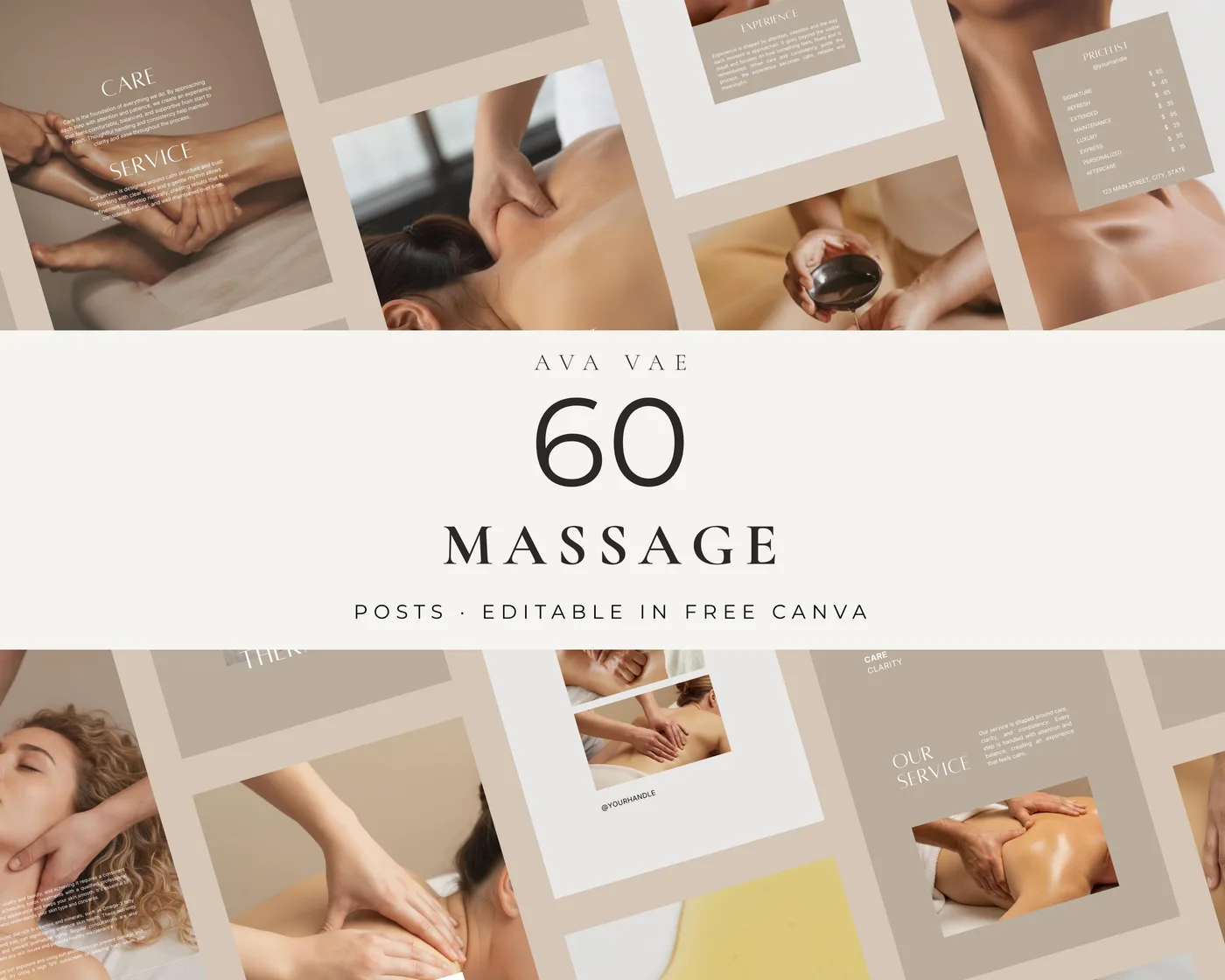
Your Instagram’s job is not to chase reach; it’s to make a stranger exhale. Aim for a feed that transmits calm the way your room does: warm light, textures, clean lines, quiet colors. The content pillars are simple. The space: fresh linens, warm towels, the corner where coats and worries get left. Education: what to expect at a first visit, how to prepare, how often clients typically like to come, answered without medical promises. The practical: openings, packages, gift certificates, posted in a clean branded layout rather than a typed screenshot. And just enough of you: why you do this work, one honest paragraph, goes further than any trend. A set of massage Instagram templates keeps all of it in one serene, recognizable style, openings and education included, and our massage post templates are built exactly for that calm-first look.
The rebooking rhythm
Massage has a natural cadence: the client who feels the difference wants to feel it again, and your job is simply to make regularity easy. Invite the next appointment at checkout, while the benefit is still in the body: “most clients with weeks like yours come every three or four weeks, shall we look at a date?” Offer a small series or membership so regular care becomes a standing decision instead of twelve separate ones. Follow up gently: a thank-you message the next day, a friendly check-in when their usual interval comes around. None of this is pushy; it’s the same care you show on the table, extended to the calendar.
Seasons, gifts and the long game
Two seasonal notes worth planning for. Gift season is enormous for massage, an hour of rest is one of the most naturally giftable services there is, so have certificates designed and visible by November; the gift certificate guide walks through the whole Q4 timeline. And January’s self-care wave rewards practices that spent the fall building trust. Through all of it, keep the fundamentals steady: a complete Google profile, a website that answers, an intake that impresses, a calm feed, a rebooking habit, and a clear, beautiful price list, which is exactly what our free price list template gives you in ten minutes. Consistency is the whole secret; it’s just spelled out in small, repeatable pieces.
Keep reading
Hair
Salon Social Media Content Calendar: What to Post Every Week
The 9pm what-do-I-post panic is a planning problem, not a creativity problem. A weekly skeleton, post ideas per niche and a batching routine that actually holds.
Beauty
How to Price Your Salon Services (+ Free Price List Template)
Most salon prices were inherited, guessed or copied. A calm guide to pricing your services on purpose, raising them without panic, and presenting them beautifully.
Beauty
Faceless Reels for Beauty Businesses: Ideas That Don't Need Your Face
You can grow on reels without dancing, pointing or talking to a camera. The faceless formats that fit beauty work, with concrete ideas per niche.