Short answer: To start a spray tan business, get trained in application and skin tone matching, check what your state and city require, pick a model (mobile, home studio, salon suite or a room inside a salon), buy a reliable spray system, tent and solutions, insure the business, set prices that cover product and time, prepare your consent, prep and aftercare paperwork, and book your first clients through Instagram, Google and local partners. Below is each step in the order that saves you money and mistakes.
Spray tanning is one of the most approachable beauty businesses to start. You do not need a big salon, the equipment fits in a car, and demand is driven by events people already have on the calendar: weddings, proms, vacations, holidays. What separates the tanners who stay booked from the ones who quit after one summer is almost never the solution. It is the setup, the pricing and the marketing.
Step 1: Get trained and certified
Start with a spray tan certification course. Most solution brands and beauty academies offer one, online or in person, and many take a day or a few days. A good course covers:
- Skin types, skin tones and how to choose the right solution strength
- Application technique, including hands, feet, knees and the back
- Prep and aftercare instructions for clients
- Contraindications and when not to tan someone
- Hygiene, ventilation and protective measures for you and the client
Certification is not always a legal requirement, but it is what makes your first tans look natural, and clients and insurers often ask for it. Practice on friends and family before you charge anyone. Twenty practice tans teach you more than any manual.
Step 2: Check your state and local rules
The rules for spray tanning differ by state. Some states treat it as part of cosmetology or esthetics and expect a license, others do not regulate it at all. Before you spend money, check three things:
- Your state board of cosmetology: whether spray tanning needs a license where you live
- Your city or county: a general business license, and zoning rules if you want to work from home
- Your state tax office: a sales tax permit if you plan to sell aftercare products
Then choose a business structure. Many solo tanners start as a sole proprietor or set up an LLC. An accountant can tell you which makes sense for your situation in one short call.
Step 3: Choose your business model
The model you pick decides your costs, your prices and how you market yourself.
| Model | Best for | Watch out for |
|---|---|---|
| Mobile spray tanning | Starting with low overhead, bridal parties, events | Travel time, setting up in different rooms, a reliable car |
| Home studio | Low rent, flexible hours | Zoning, privacy, a space clients feel comfortable in |
| Salon suite | A professional look and your own brand | Weekly or monthly rent from day one |
| Room inside an existing salon | Built-in foot traffic and referrals | Commission or rent split, less control over hours |
A mobile spray tanning business is the most common starting point because it skips rent. Many tanners start mobile, build a client list and move into a suite once their calendar is full. If you go mobile, group your appointments by area and add a travel fee for anything outside your main zone.
Step 4: Buy the right equipment and supplies
You do not need the most expensive kit, but you do need equipment that sprays evenly every time. A starter list:
- Spray system: an HVLP (high volume, low pressure) machine or airbrush unit made for tanning
- Pop-up tent with extraction or good ventilation, to keep overspray off walls and out of the air
- Solutions in two or three strengths, so you can match light, medium and deep skin tones
- Barrier cream for hands, feet, nails and dry areas
- Disposables: sticky feet, hair caps, disposable underwear
- A mat or floor protector, towels and cleaning supplies
- Good lighting, ideally a ring light or portable lamp, so you can see your coverage
- A booking and payment system with deposits, so no-shows do not cost you product and time
Airbrush tanning businesses and HVLP-based ones work the same way as a business. The difference is the tool and the finish, and your training course will usually help you choose.
Step 5: Insure your business
Get insurance before your first paid tan. Most beauty pros carry general liability (a client slips on your mat) and professional liability (a client says a tan caused a reaction or ruined an event). If you work mobile, check whether your car insurance covers business use. Many beauty insurance providers offer spray tan policies for solo artists, so compare two or three quotes.
Step 6: Set your prices and do the profit math
"Is a spray tan business profitable?" is the question everyone asks, and the honest answer is: it depends on your price, your product cost per tan and how many tans you do per week. Do this math once before you publish prices.
- Product cost per tan: solution, barrier cream, disposables and a share of cleaning supplies
- Time per tan: setup, consultation, spraying and cleanup (and travel, if mobile)
- Fixed monthly costs: insurance, booking software, rent or car costs, marketing
- Your price minus product cost, multiplied by your tans per month, minus fixed costs, is your profit
Example numbers only, not market data: if your product cost is $8 per tan, you charge $50 and you do 40 tans a month, that is $1,680 before fixed costs. If those are $400 a month, you keep $1,280. Swap in your own numbers and you will see exactly how many tans you need per week.
To find your price, look at what three to five tanners in your area charge, then decide where you sit. Offer a few clear options instead of a long menu: a single tan, a rapid tan, a bridal package and a group or party rate. Our free salon price list template gives you a clean, editable menu to post and print.
Step 7: Prepare your client paperwork
Professional paperwork protects you and makes clients trust you faster. You need:
- A consent and intake form: skin sensitivities, allergies, medications that affect the skin, recent waxing or peels
- Prep instructions: exfoliate the day before, shave or wax at least 24 hours before, no lotion, deodorant or makeup on the day
- Aftercare instructions: how long to wait before the first rinse, moisturizing, what fades a tan
- Booking and cancellation policy: deposits, late arrivals, no-shows
Send prep instructions when someone books and aftercare right after the appointment. It cuts down on streaky tans, and on the messages that come with them.
Step 8: Get your first clients
A new spray tan business fills its calendar through local visibility, not national reach. Start here:
- Instagram: set up a business profile with your city in the name field, a clear bio and a booking link. Post results, prep and aftercare tips and open slots. Our spray tan Instagram captions give you 60+ ready-to-post lines.
- Google Business Profile: free, and it is how people searching "spray tan near me" find you. Ask every happy client for a review.
- A launch offer for friends and family: a reduced first tan in exchange for honest photos and reviews.
- Partnerships: wedding planners, bridal shops, photographers, hair and makeup artists, dance studios and gyms all have clients who need a tan before a big day.
- Event season planning: prom, wedding season, summer and the holidays. Announce availability weeks ahead.
For the full marketing plan, including rebooking rhythms and event season offers, read the spray tan business marketing guide.
Frequently asked questions
Do you need a license to start a spray tan business? It depends on your state. Some states require a cosmetology or esthetics license for spray tanning, others have no specific rule. Check with your state board of cosmetology, and get a general business license from your city or county either way.
How much does it cost to start a spray tan business? The main costs are training, a spray system, a tent, solutions and disposables, insurance and a booking system. Starting mobile is usually the lowest-cost route because you skip rent. Price out each item from the list in step 4 before you commit.
Is a spray tan business profitable? It can be, once your price comfortably covers product cost per tan and your time, and you have enough repeat clients. Run the profit math in step 6 with your own numbers to see how many tans per week you need.
Can you run a spray tan business from home? Yes, many tanners start with a home studio. Check your local zoning rules, make sure the space is ventilated and private, and get insurance that covers clients visiting your home.
How long does it take to start a spray tan business? Many people go from certification to their first paying client in a few weeks: training, practice tans, paperwork, insurance and a simple Instagram and Google presence. Event season is the best time to launch, so start preparing a couple of months ahead.
Look established from your very first post
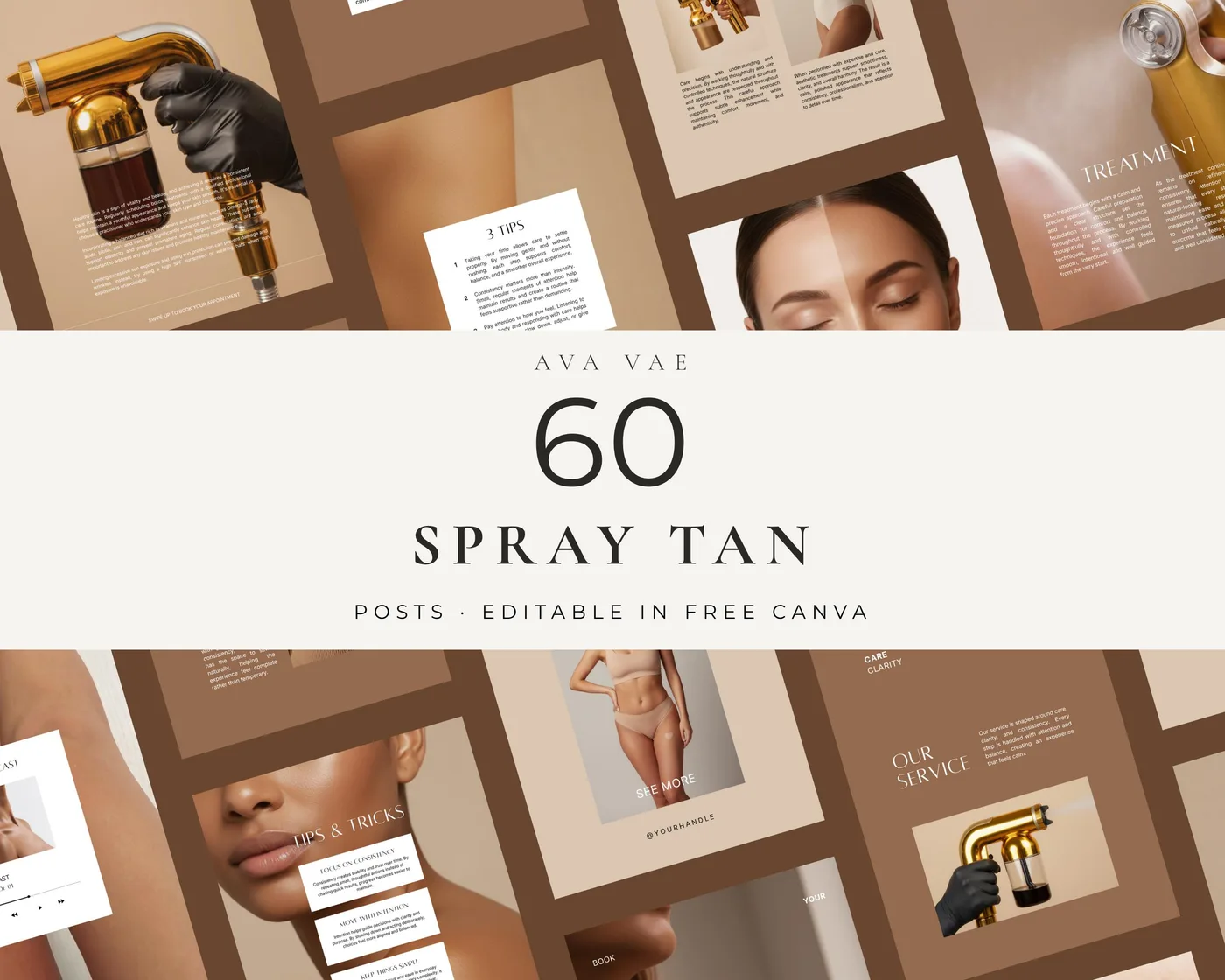
New clients judge a spray tan business by its Instagram before they ever book. The Spray Tan Instagram Post Templates give you editable layouts for results, prep tips, price lists and booking posts, and the Spray Tan Instagram Story Templates cover open slots, aftercare reminders and FAQs. Everything edits in the free version of Canva. Want posts, stories and reels in one matching set for launch? That is the Spray Tan Instagram Bundle, and every style is on the spray tan templates page.
Ava
Keep reading
Spray Tan
Spray Tan Business Marketing Guide
Spray tanning is a local, seasonal, referral-driven business. A concrete plan to go from your first clients to a booked calendar, event season included.
Spray Tan
Tanning Quotes and Spray Tan Captions
Tanning quotes and spray tan captions for Instagram: spray tan quotes, funny and cute captions, salon slogans, plus 60 captions sorted by goal.
Beauty
How to Price Your Salon Services
Most salon prices were inherited, guessed or copied. A calm guide to pricing your services on purpose, raising them without panic, and presenting them beautifully.